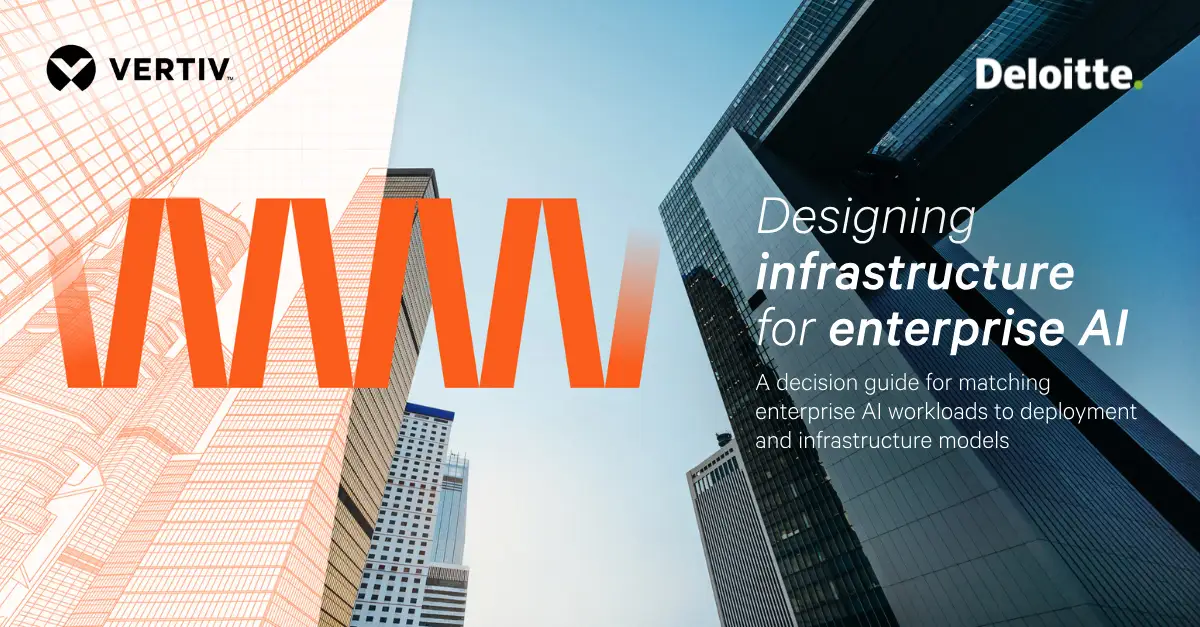
Moving artificial intelligence from a simple experiment into sustained production is rarely straightforward. To address this exact bottleneck, Vertiv alongside the Deloitte Center for Integrated Research and digital infrastructure research firm STL Partners has officially rolled out a comprehensive new framework. Titled the Designing Infrastructure for Enterprise AI Guide, this release aims to help businesses navigate the intricate physical infrastructure requirements needed to support modern AI deployments.
Bridging the Gap Between AI Ambition and Reality
As organizations transition their AI strategies forward, the main hurdle is often no longer just choosing the right software model. Instead, it is figuring out whether the physical environment can handle it. Factors like available power density, advanced cooling solutions, network connectivity, and facility operational capacity ultimately dictate where a workload can run safely and efficiently.
To cut through the complexity, the newly released guide introduces a structured, four-step process for IT and facilities leaders:
- Define: Establish the intended business outcome and the specific nature of the AI workload.
- Evaluate: Assess the workload scale, performance demands, and overall operating requirements.
- Determine: Pinpoint the most suitable deployment location.
- Match: Align the workload and location with the correct physical infrastructure model and reference design.
Commenting on the launch, Giordano Albertazzi, CEO of Vertiv, noted:
“The next phase of enterprise AI will be shaped not only by models and computing, but also by where organizations can provide the power, cooling, connectivity and operating environment each workload requires. By starting with the workload, enterprises can make infrastructure decisions earlier, identify constraints sooner and build a more credible path from AI ambition to production.”
Echoing this perspective, Nicholas Merizzi, principal, Silicon2Service U.S. Lead, Deloitte Consulting LLP, added:
“The economics and operating requirements of AI change as workloads move into production. Organizations need to connect business value, governance, operating ownership and infrastructure together. Bringing those questions into the planning process earlier gives leaders a stronger basis for deciding where AI workloads should run and how they should be supported over time.”
Categorizing Workloads and Infrastructure Models
Recognizing that enterprise AI consists of a diverse portfolio rather than a single uniform requirement, the research divides workloads into six distinct archetypes covering model development, retraining, and various production use cases.
To match these demands, organizations can leverage four standardized physical infrastructure models:
- Edge AI Cluster
- Small AI Cluster
- Large AI Cluster
- High-Density AI Cluster
These physical models provide a solid baseline for managing power, heat dissipation, controls, and future scalability. By conducting early site assessments, enterprises can successfully mitigate deployment risks long before physical hardware ever arrives on site.
For organizations looking to dive deeper into the technical framework and infrastructure blueprints, the full guide is available directly through Vertiv’s official insights portal.