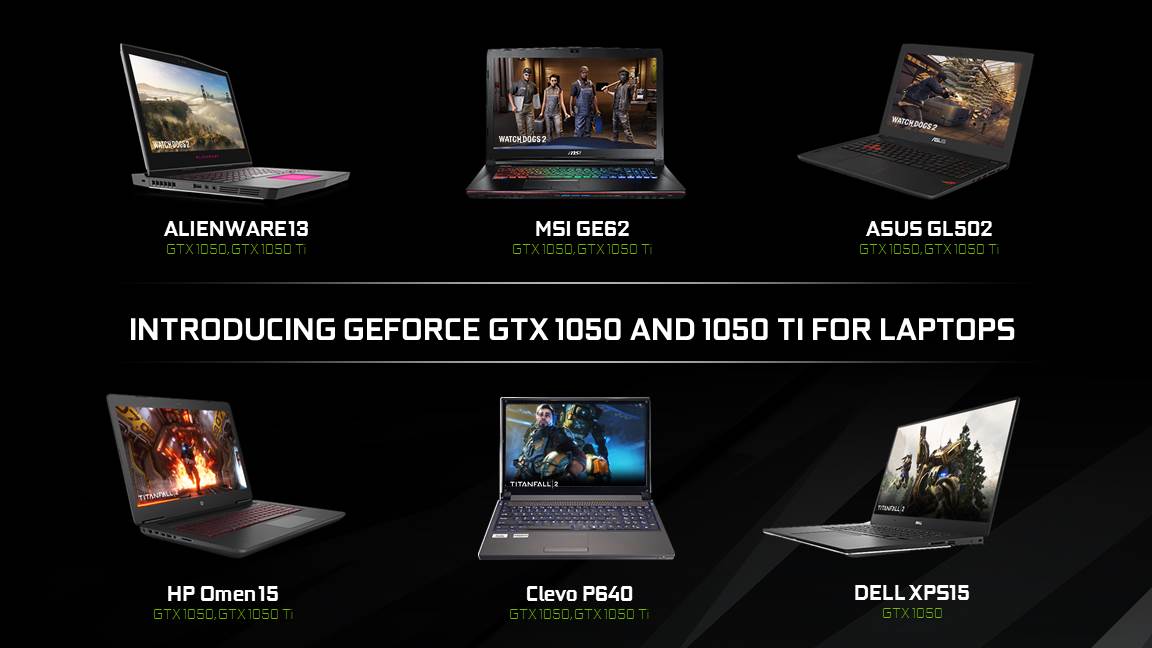
With NVIDIA announcing GTX 10 Series for gaming notebooks back in August 2016, it’s just the matter of time before the entry level GTX 1050 and GTX 1050 Ti joining the game and after 2 months of waiting, today is finally the day. As NVIDIA today officially announces the availability of both the GTX 1050 and GTX 1050 Ti for gaming laptops from over 30 participating partners i.e Sager, Gigabyte, Lenovo, Clevo, EVGA, Alienware, ASUS, MSI , HP, Acer, Razer, Origin, XMG, etc within the first quarter of 2017.
Specifications
1050 Notebook | 1050Ti Notebook | 1050 Desktop | 1050Ti Desktop | |
Graphics Processing clusters | 2 | 2 | 2 | 2 |
Streaming Multiprocessors | 5 | 6 | 5 | 6 |
CUDA Cores (Single Precision) | 640 | 768 | 640 | 768 |
Texture Units | 40 | 48 | 40 | 48 |
ROP Units | 16 | 32 | 16 | 32 |
Base Clock | 1354 MHz | 1493 MHz | 1354 MHz | 1290 MHz |
Boost Clock | 1493 MHz | 1620 MHz | 1455 MHz | 1392 MHz |
Memory Clock | 3500 MHz | 3500 MHz | 3504 MHz | 3504 MHz |
Memory Data Rate | 7 Gbps | 7 Gbps | 7 Gbps | 7 Gbps |
L2 Cache Size | 1024 KB | 1024 KB | 1024 KB | 1024 KB |
Total Video Memory | Up to 4096 MB | Up to 4096 MB | 2048 MB | 4096 MB |
Memory Interface (GDDR5) | 128-bit | 128-bit | 128-bit | 128-bit |
Total Memory Bandwidth | 112 GB/s | 112 GB/s | 112 GB/s | 112 GB/s |
Texture Rate (Bilinear) | 54.2 GigaTexels/s | 71.7 GigaTexels/s | 54.2 GigaTexels/s | 61.9 GigaTexels/s |
Fabrication Process | 14nm | 14nm | 14nm | 14nm |
Transistor Count | 3.3 Billion | 3.3 Billion | 3.3 Billion | 3.3 Billion |
Just like the rest of the GTX 10 Series graphics for notebooks, both the GTX 1050 and GTX 1050 Ti for notebooks features specifications of CUDA cores count, Texture and ROP units, etc that comes very near to its desktop counter part – well, except for the 1050 Ti notebook that comes with a rather significant boost on both its base clock and boost clock.
It is known that both the GTX 1050 and GTX 1050 Ti doesn’t comes with enough power to make the system that it’s powering a VR ready gaming machine, but notable features from NVIDIA such as the Ansel, GPU Boost 3.0, Optimus, GameWorks, and G-SYNC alongside industry APIs such as DirectX 12, OpenGL 4.5, and Vulkan is still something that will be supported by both GPUs.
Gaming Performance

Performance wise, as we don’t have any gaming notebooks here that is powered by both the GTX 1050 and GTX 1050 Ti GPUs, here’s some numbers from NVIDIA, with some of the AAA titles tested on the MSI GP62 and MSI GE62 that is powered by the GTX 1050 and GTX 1050 Ti respectively.
If you happens to be around CES this week, you’ll be able to get your hands on a variety of models including those from Acer, Alienware, ASUS, Dell, HP, Lenovo and MSI. Many models will be available for sale this week, with all of them featuring Intel’s newest Kaby Lake platform for laptops. Pricing will vary from OEM, but according to NVIDIA, we can expect to see retail pricing starting at around $699 USD.
(Source: NVIDIA)
-advertisement-