On the other side of the spectrum at CES 2025, AMD also officially revealed the long-teased “Strix Halo” APUs through the official name Ryzen AI Max.

These chips are the epitome of AMD’s engineering for laptop gaming thanks to the e Zen 5 CPU cores, RDNA 3.5 integrated graphics, and an NPU, solidifying their focus on advanced AI and creative workloads. Not only that, its unified coherent memory architecture supports upwards of 96GB system RAM with a bandwidth of 256 GB/s, making laptops as powerful as desktop machine when it comes to mobile AI workstation.
here’s a quick specs rundown before we move further.
Model | Cores/Threads | Compute Units (CU) | Boost Clock | Cache | TOPs | TDP |
Ryzen AI Max+ 395 | 16/32 | 40 | 5.1 GHz | 80MB | 50 | 45W-120W |
| Ryzen AI Max 390 | 12/24 | 32 | 5GHz | 76MB | ||
Ryzen AI Max 385 | 8/16 | 40MB | ||||
Ryzen AI Max 380 Pro | 6/12 | 16 | 4.9GHz | 22MB |
While one may find the bulky amount of GPU CUs beats over pretty much any handheld gaming PCs out there, these are not for them unfortunately and instead, for thin and light laptops that couldn’t afford to have a discreet GPU jammed into the chassis. With that being said, it is still possible for AMD and partners to do otherwise because the NPU module is still ahead of a GPU when it comes to power efficiency in running AI features and models.
As for benchmarks, Team Red recorded an average of 1.4x higher GPU performance and 2.6x faster rendering speed against the Intel Core Ultra 9 288V yet this is only on the surface level of comparison as users need to know the pricing of laptops carrying the processor which AMD did not disclose at the event.
A side note, business-focused PRO variants cover the above SKUs while the standard models are only available in 395, 390, and 385.
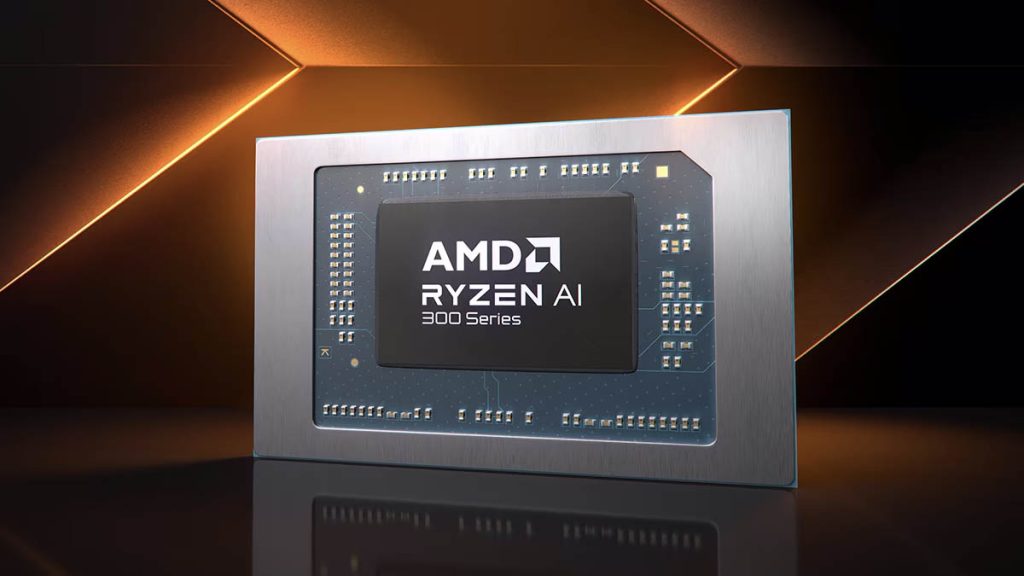
On the other hand, the standard Ryzen AI 300 series welcomes the Ryzen AI 7 350 and Ryzen AI 5 340 to expand the portfolio for more options when it comes to mid-range laptops for a balanced cost-performance ratio.

Compared to the existing lineup, these come with a slightly lower boost clock with the rest of the specs remaining almost identical. The PRO version mimics the standard variants in terms of architectural design but adds business-tailored features and protection for a safer operating environment.
The Ryzen AI 7 350 in particular wins over competition from Qualcomm and Intel, reporting a 30% and 54% lead in the Cinebench R24 multicore test while other tests also show an “AMD W”.

Lastly, AMD continues its commitment in terms of older platform support through a total of 11 new SKUs that include 4 PRO variants that offer higher clock speeds over the Ryzen 8040/45 counterparts. While these may seem “old” to some people but the fact that they could still provide adequate performance at a much lower cost means that the budget market will still accept machines running these chips.