NVIDIA’s SIGGRAPH 2024 which focuses on AI and graphics-related technology concluded last week so here’s a quick rundown of some of the important stuff revealed over there.
Hi There James

Some of you might know about the NVIDIA ACE demo where they have you play as a detective that goes around a hotel interacting with staff and NPCs that can respond to you in real-time via natural language processing. The one revealed at SIGGRAPH 2024 is a bit different though as it is geared towards real-world application at the professional level.
Meet “James”, an interactive digital human built on NVIDIA NIM microservices that can be fitted into different sectors and positions for on-demand customer interactions using AI-driven backbone and software. In its current state, it is created for customer service or deployed a s a virtual assistant and responds with appropriate responses that are contextually correct. It can also be further tuned to carry different emotions and humor.
For those who are eager to interact with him, he’s currently in the final phase of preparation and when it’s done, you can go here to have a look at him.
Aside from this, related NVIDIA Maxine AI platform for telepresence consisting of Maxine 3D and Audio2Face-2D as well as partnered companies came together to announce a variety of technology cross-adoption to help developers around the world to leverage Maxine and ACE to create more engaging and natural interactions for people using digital interfaces across industries and sectors in the future.
NVIDIA x Filmora
There’s no doubt that NVIDIA’s GeForce RTX and pro-class RTX GPUs are extremely good at video-related acceleration to pump out ultra-high definition files at record-breaking speed. Starting from now, Wondershare Filmora and Davinci Resolve will be turning the RTX Video HDR feature on.
Utilizing powerful AI algorithms, one can easily transform SDR content into HDR with richer colors and greater detail in light and dark scenes with just a flick of a switch (or button press) to deliver a more lifelike and immersive video to viewers. Adding that with RTX Video Super Resolution creates an even better video quality thanks to the removal of encoding artifacts as well as overall detail enhancements.
You can learn more about it through Filmora’s official announcement of this partnership.
Expanded AI Tools for 3D Artists
For graphic artists specializing in 3D modeling for renders and games, new tools have been revealed for several applications including Replikant, Adobe, Topaz, and Getty Images. We’ll list them out in a point form for easier rundown:
- Replikant – NVIDIA Audio2Face integration; Available on Steam, the AI-assisted 3D animation platform can now push out real-time visuals enhanced by RTX and NVIDIA DLSS
- Adobe Substance 3D – New generative AI features for Substance Modeler; Firefly integrated into Substance 3D Sampler + Stager
- Topaz AI – NVIDIA TensorRT acceleration added for significant rendering speed improvements; Highly scalable according to GPU count
- Getty Images – Better image generation and quality via Generative AI by iStock; Vastly improved Text-2Image and Image-2Image functionalities thanks to NVIDIA Edify
Better than Ever ChatRTX
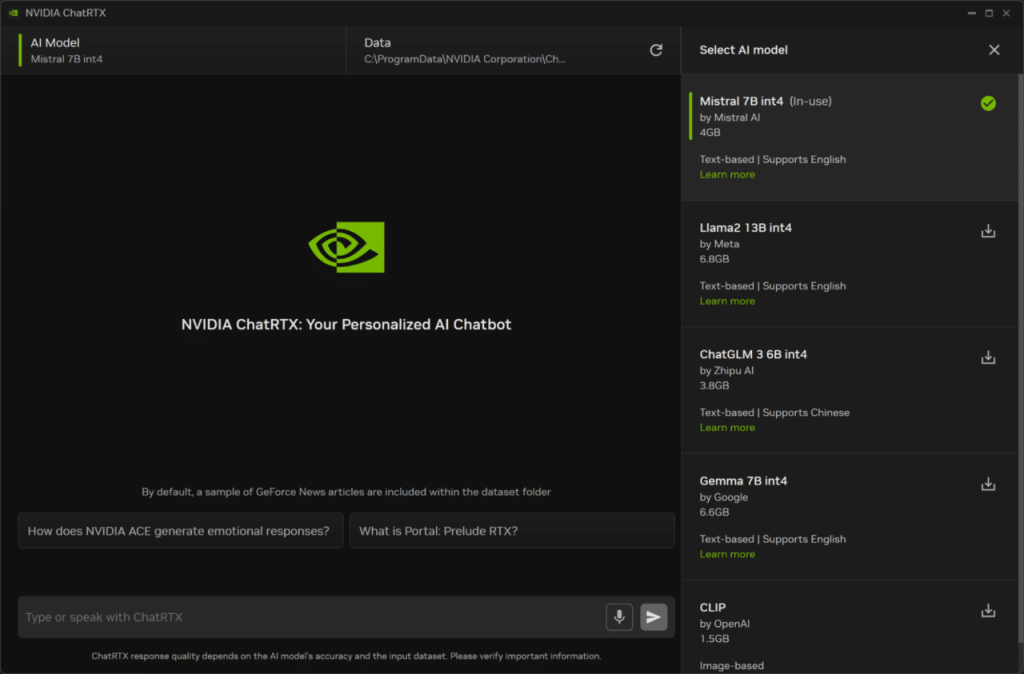
Although the initial release of ChatRTX is a bit clunky and “not so powerful” compared to competitors of OpenAI and Google, it is now back with a better UI that is cleaner and better polished to serve various publicly available LLMs and providing demonstration of RTX-accelerated Retrieval-Augmented Applications (RAG).
The latest version utilizes Electron + Material UI framework, allowing developers to add their own UI elements or extend the technology’s functionality in addition to a new architecture that simplifies integrating different UIs and streamlines building new chat and RAG applications on top of the ChatRTX backend API.
End users can either grab the new version over here or through GitHub.
Industry Partners Demo
Dell and HP have come out with several AI initiatives by demonstrating how they and enterprise clients can utilize NVIDIA’s suite of AI software and solutions to gain an advantage in the playfield.
For Dell, they showed the acceleration of AI development through an optimized RAG chatbot using NVIDIA AI Workbench and an NVIDIA NIM microservice for Llama 3 that interacts with enterprise data embedded in a local vector database. Inference methods are flexible as it can run locally on a Hugging Face TGI server, in the cloud using NVIDIA inference endpoints, or on self-hosted NVIDIA NIM microservices.
Meanwhile, HP presented Z by HP AI Studio tackling data science topics with the latest NVIDIA CUDA-X libraries and HP’s partnership with Galileo, a generative AI trust-layer company. The platform offers aster project deployment, easy collaboration, and seamless switching between online and offline modes, enhancing productivity and streamlining AI development.
Stable Diffusion Optimizations
Just short and simple – Stable Diffusion 3.0 is now 60% faster via TensorRT while NIM microservice for Stable Diffusion 3 is available for preview over at ai.nvidia.com.