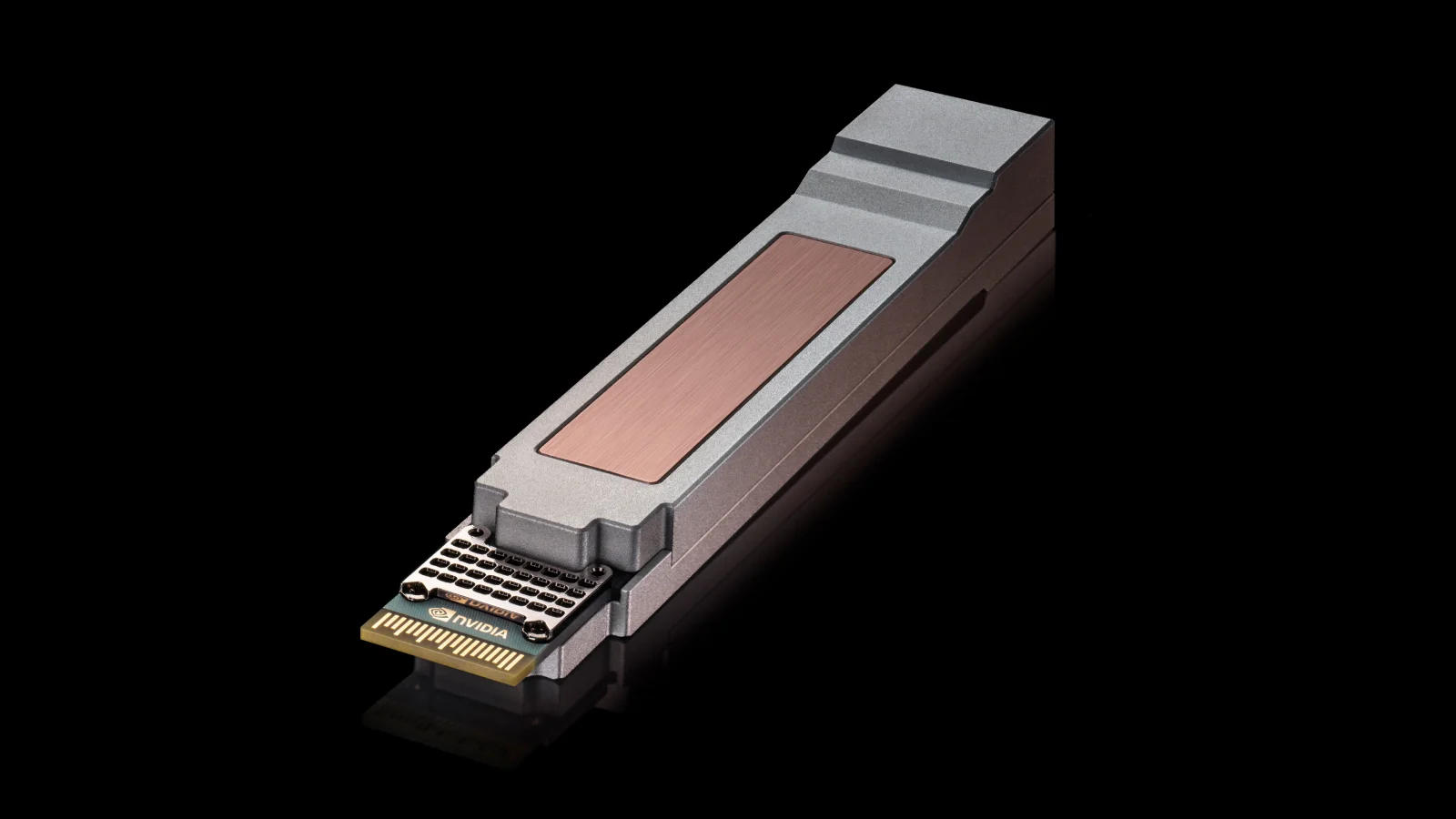
NVIDIA and Cisco have announced plans for Ultra-Dense Small Form Factor Pluggable (USFP), a new high-density optical module with 400Gb/s per lane, aimed at the next generation of AI factories that use pluggable transceivers.
As AI models grow and inference demand expands, AI factories need more bandwidth per connection and more connections per switch. Once a switch hits capacity, expanding the network usually means adding switch layers and optical links, which raises latency, power use, and cost.
Therefore, USFP is meant to let builders move from 200Gb/s per lane to 400Gb/s-per-lane Ethernet AI fabrics without overhauling their data center infrastructure, while keeping the pluggable deployment model that has been proven across multiple network generations.
The first planned USFP transceivers pack 16 full-duplex lanes into an OSFP-sized footprint, supporting both switches and SuperNICs, with room to expand to 32 or more lanes later. By doubling both lane count and per-lane bandwidth, USFP lets AI fabrics connect more 1.6Tb/s endpoints without adding network tiers, and customers can reach 12.8Tb/s of overall capacity.
Both parties also explained the design choices for the USFP from 3 aspects:
- Connector: A new two-dimensional array connector with a two-step insertion design that engages high-speed contacts after the module is inserted. That reduces contact wear, improves signal integrity, and makes insertion force more predictable. It also allows lane counts to scale to 32 and beyond, and it improves performance at 200Gb/s per lane.
- Thermals: Supports up to 100 watts of power dissipation without a separate embedded cooling circuit inside the transceiver, which reduces switch design complexity and improves reliability.
- Optics: All configurations support optical designs that cut latency and power by simplifying signal processing, with a range of optical technologies and distances available.
Currently, NVIDIA and Cisco are working with TE Connectivity and Amphenol to build USFP cages, connectors, and modules, with more partners expected. The work builds on existing efforts to make NVIDIA Spectrum-X Ethernet and Cisco Silicon One-based networks work together.
The two companies also plan to create an open industry specification for USFP through an upcoming community-led multi-source project.