BFSI companies face a major challenge in today’s digital-first economy: legacy infrastructure that lacks the flexibility and scalability required for rapid innovation and evolving customer expectations. To remain competitive, organizations need cloud migration strategies that accelerate innovation, elevate customer experience, and enable scalable growth. Saroj Patra—a seasoned cloud transformation leader with over 24 years of experience—outlines a tried-and-tested modernization framework grounded in phased execution, business-aligned planning, and cloud-native tools. This article offers financial institutions a clear path to modernize core systems, overcome legacy limitations, and deliver faster, smarter, and more scalable financial services.
The financial services industry is evolving fast, driven by rising customer expectations, regulatory demands, and relentless competition from digital-first players. However, too many institutions are still held back by outdated mainframes and legacy systems. These limitations aren’t just slowing innovation—they’re threatening long-term relevance.
For banks, insurers, and financial service providers (BFSI), cloud migration is no longer optional. Today, it’s the strategic pathway to modernization—enabling scalability, efficiency, and sustainable growth.
With over 24 years of experience leading legacy modernization and cloud transformation across the BFSI sector, I’ve seen how the right technology, paired with a clear, outcome-driven strategy, can unlock real, lasting business value.
In this article, I will share proven approaches that help organizations move beyond legacy limitations and turn cloud migration into a meaningful transformation.
The Challenges of Legacy Systems in the BFSI Sector
In my experience, legacy systems in the BFSI sector are not just outdated—they are deeply ingrained in the organizational culture. The slow, costly, and rigid nature of mainframes and monolithic applications hinders agility and scalability, creating significant challenges for organizations.
Some of the key issues include:
- High Operational Costs: Maintaining legacy systems is expensive, requiring constant patches, updates, and specialized staff.
- Limited Agility and Scalability: These systems struggle to adapt quickly to changing market demands, slowing down the launch of new products and services.
- Slower Time-to-Market: Delays in launching financial products due to outdated systems stifle growth opportunities.
- Inability to Meet Growing Customer Demands: Legacy systems are often incapable of scaling to accommodate increasing customer needs or expanding into new markets.
- Outdated Infrastructure: Many legacy systems were never designed to integrate with cloud technologies, creating a significant barrier to modernization.
As customer expectations rise and regulatory pressures grow, legacy systems become an even greater obstacle to staying competitive. So, how can BFSI organizations modernize their infrastructure to keep up? By embracing cloud-powered banking.
Financial institutions are increasingly migrating to cloud technology to reshape their core operations and overcome the limitations of legacy infrastructure. Beyond traditional data analytics and development environments, banks are leveraging the cloud to enhance customer experiences, strengthen data security and fraud detection capabilities, and reduce operational costs. Cloud adoption also fosters eco-friendly banking structures, supports seamless business continuity, and significantly boosts operational efficiency. Together, these benefits are helping banks build more resilient, agile, and future-ready infrastructures, essential for staying ahead in a rapidly evolving financial landscape.
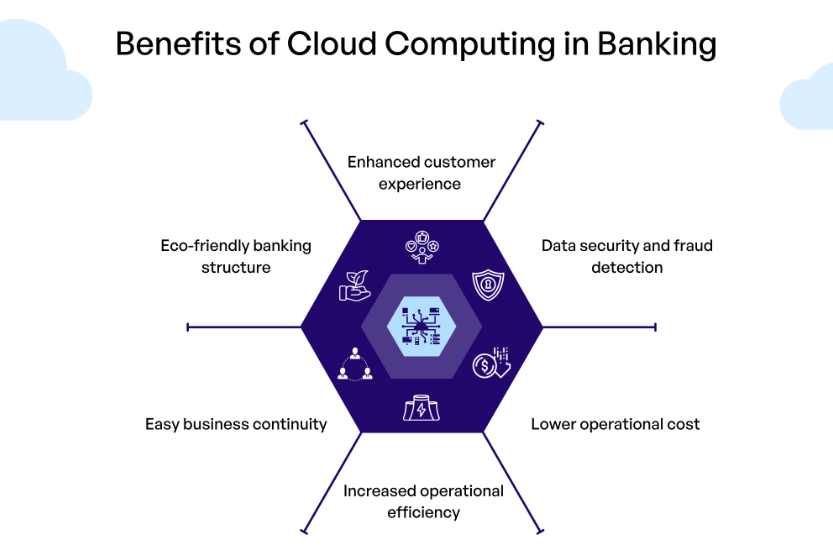
Source: Appventurez
Building a Strategic Roadmap for Cloud Migration
To effectively tackle the challenges of legacy systems, it’s crucial to start with a strategic roadmap for migration. This roadmap should be more than just a technical guide—it needs to be aligned with the organization’s business goals. The success of a cloud migration hinges not only on solving technical problems but also on ensuring that the process delivers tangible business value at every stage.
Industry leaders echo this perspective. Daniel Pinto, COO of JPMorgan Chase, emphasized the strategic advantage of modernization:
“We spent a lot of time on his views on the importance of technology modernization, and how that will give [JPMorgan] the ability to innovate and develop products at speed as well as reduce the cost to operate the business over time.”
— Daniel Pinto, MarketWatch
Aligning Business Goals with Cloud Strategy
A successful cloud migration starts by aligning the organization’s business goals with the right technology solutions. Whether the goal is to enhance customer experience, improve operational efficiency, or accelerate time-to-market for new products, a cloud migration strategy must always prioritize delivering measurable business value. This alignment ensures that the migration is not just a technical shift, but a strategic move that supports the broader objectives of the business.
Assessment of Current Infrastructure
Once business goals are aligned, the next critical step is to assess the existing infrastructure. Legacy systems, such as mainframes, often require significant reengineering before they can be moved to the cloud. Identifying which systems can be migrated directly and which need to be re-engineered is essential for a smooth transition.
In one case, we re-engineered a financial institution’s mainframe systems and migrated them to scalable, distributed microservices. It’s also essential to assess workloads, performance, security, and compliance to determine which systems are suitable for cloud migration.
Phased Migration Approach: Mitigating Risks and Ensuring Success
A phased approach remains one of the most effective strategies for executing large-scale cloud migrations. By breaking the transition into structured, manageable phases, organizations can minimize disruption, reduce risk exposure, and accelerate cloud adoption with greater confidence.
During a recent migration project for a leading bank, we began with non-critical applications to validate key processes and refine our approach. Each subsequent phase built on that success, enabling a smooth transition for mission-critical systems and aligning with the bank’s broader cloud-first strategy.
The table below outlines a typical phased migration model used in cloud transformation projects:
| Phase | Focus Area | Key Benefits |
| Phase 1 – Pilot | Non-critical applications | Low risk, validates process, minimal operational disruption |
| Phase 2 – Core Systems | Customer-facing and core platforms | Enables scalability testing and platform optimization |
| Phase 3 – Critical | Mission-critical, high-availability apps | Unlocks full performance, reduces downtime |
| Phase 4 – Optimization | Monitoring, automation, cost control | Fosters continuous improvement and business agility |
Leveraging Cloud-Native Tools and Platforms for Efficient Migration

(Image: Shutterstock)
Ensuring a smooth and efficient migration process is highly dependent on selecting the right tools that align with your organization’s cloud objectives. Over the years, I’ve found that cloud-native tools are indispensable for simplifying and automating key aspects of migration.
1. Terraform and Ansible for Seamless Automation
Throughout my projects, tools such as Terraform and Ansible have been instrumental in streamlining migrations. These cloud-native platforms provide essential functionalities to ensure a seamless migration process.
Terraform enables teams to codify infrastructure and automate its deployment, ensuring consistency across environments. Ansible simplifies software configuration, management, and updates. Together, these tools reduce errors, ensure deployment consistency, and enhance scalability during the migration process.
2. Kubernetes for Scalable Microservices
Kubernetes is an open-source platform designed to automate the deployment, scaling, and management of containerized applications. It plays a pivotal role in managing microservices. By containerizing applications and using Kubernetes for orchestration, organizations can achieve greater flexibility and scalability, ensuring that different parts of the business can evolve independently while still working seamlessly together in the cloud environment.
3. DevOps and Automation for Faster Deployments
Cloud migration isn’t just about moving systems to the cloud—it’s about transforming how development and operations teams work together. By leveraging DevOps tools such as Jenkins, GitHub, and Azure DevOps, organizations can integrate their workflows more effectively, improve deployment speed, reduce errors, and foster continuous improvement across teams.
Real-World Example of Cloud Migration Success
Over the past two decades, I have had the opportunity to lead numerous cloud migration projects that have driven meaningful transformation. One such project involved migrating a contact center for a major BFSI client, showcasing how cloud technologies can enhance scalability, improve customer experience, and reduce operational costs.
Case Study: Migrating a Contact Center to Cloud-based Cisco IP Solution
One of the projects I led at Infosys involved migrating a contact center for a BFSI client from a traditional on-premises system to a cloud-based Cisco IP solution. The client was experiencing challenges with scalability, long response times, and inefficient service workflows, which were hindering customer experience.
Challenge
The client’s existing infrastructure could not handle the growing demand for customer support and was affecting the quality of service. With customers demanding faster responses, the legacy system was becoming a barrier to delivering effective solutions.
Solution
We moved the contact center to a cloud-based Cisco IP system and integrated AI-powered tools to automate workflows, reduce wait times, and improve overall customer satisfaction.
Results
The migration allowed the client to handle an increased volume of customer queries without the need for significant additional hardware. The AI tools enabled quicker resolution of queries and better service management, leading to enhanced customer satisfaction. Ultimately, this transformation was an important step in the client’s broader digital transformation journey, aligning with their strategic cloud-first approach.
Measuring Success: Real Business Value Post-Modernization
(Image: Shutterstock)
One of the most rewarding aspects of cloud migration is seeing its tangible benefits. After migrating a client’s core banking applications, we observed improvements in transaction speeds, reduced downtime, and enhanced data analytics capabilities, which made the business more agile and competitive.
The cloud also enabled seamless integration of AI and machine learning, boosting fraud detection, personalizing services, and strengthening risk management. These outcomes reflect a broader industry trend: both large enterprises and SMEs are significantly increasing their investments in finance cloud solutions.
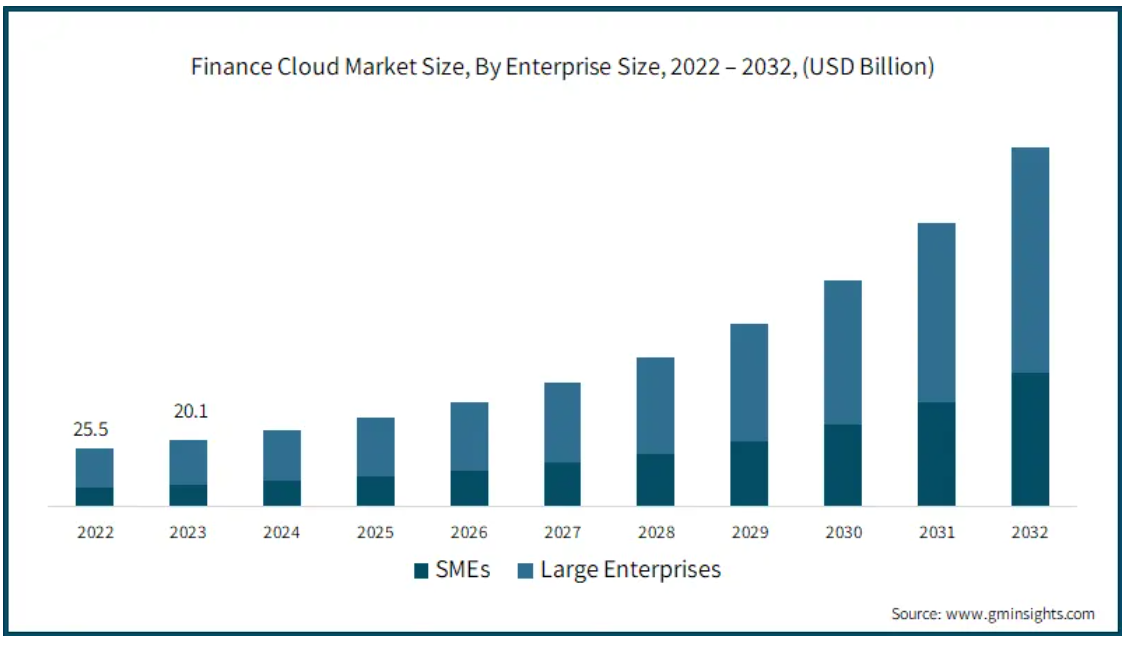
The graph illustrates that the finance cloud market is poised for exponential growth through 2032, underscoring the long-term business value of modernization initiatives across organizations of all sizes. (Source: Global Market Insights)
Building Scalable Transformation Frameworks for Long-Term Success
Creating scalable and repeatable frameworks is critical to a successful cloud migration strategy. In my experience, once an organization has successfully migrated part of its business to the cloud, that success becomes a valuable foundation for future migrations.
During a large-scale transformation for a financial services client, I led the development of a cloud migration framework that streamlined the migration of multiple business units to the cloud. This framework enabled more efficient project execution, reduced complexities, and improved operational consistency across different regions, ultimately contributing to faster migration cycles and a stronger foundation for future cloud adoption efforts.
Conclusion: The Future of Legacy Infrastructure
Cloud migration isn’t just about keeping up with the latest trends—it’s about ensuring long-term business sustainability and growth. The right strategies, tools, and methodologies can make all the difference in providing a successful transformation.
As I’ve learned throughout my career, the cloud is not a destination—it’s a journey. By modernizing legacy systems and embracing cloud technologies, BFSI organizations can unlock new opportunities, enhance customer experiences, and drive sustainable business growth.
I know that taking the first step towards modernizing your legacy systems can seem like a big leap. But rest assured, you’re not alone in this journey. With over two decades of hands-on experience in cloud transformation, I’m here to help you unlock your full potential and set your business up for lasting success.
References
Appventurez. (2024) Cloud Computing in the Banking Industry. How Is Cloud Computing in Banking Transforming It for the Better? https://www.appventurez.com/blog/cloud-computing-in-banking-industry
Cisco Systems. (2023) Cisco IP Contact Center solutions. https://www.cisco.com/
Forbes. (2022) Innovation. Cloud-Native Banking: The Key To Scalable And Resilient Financial Systems. https://www.forbes.com/councils/forbestechcouncil/2025/02/14/cloud-native-banking-the-key-to-scalable-and-resilient-financial-systems/
GitHub. (2023) GitHub Docs. https://docs.github.com/
Global Market Insights. (2024) FinTech. Finance Cloud Market. https://www.gminsights.com/industry-analysis/finance-cloud-market
HashiCorp. (2023) Terraform: Infrastructure as code software tool. https://www.terraform.io/
Jenkins. (2023) Build great things at any scale. https://www.jenkins.io/
Kubernetes. (2023) Production-grade container orchestration. https://kubernetes.io/
Microsoft Azure. (2023) Azure DevOps. Azure DevOps Services. https://azure.microsoft.com/en-us/services/devops/
Red Hat. (2023) Ansible automation platform. https://www.ansible.com/