
PCIe Gen4 SSDs have been around for a while. Still, they remain a practical choice for users who want a significant upgrade from older SATA SSDs or hard drives without necessarily moving to the latest and more expensive PCIe Gen5 platform.
For users building or upgrading a PC today, KLEVV offers several PCIe Gen4 SSD options covering different requirements. Its current CRAS lineup includes the CRAS C930, CRAS C925G, and CRAS C910G, with each model taking a slightly different approach to performance, cooling, and capacity.
Rather than looking at them as three competing products, it makes more sense to see them as different options depending on what you actually need from an SSD.
If maximum Gen4 performance and DRAM caching are the priority, the CRAS C930 is the more performance-oriented choice. For systems where a slim thermal solution and high sequential speeds are more important, the CRAS C925G offers a different balance. Meanwhile, users who simply need more storage space can look toward the CRAS C910G, which is available in capacities of up to 4TB.
KLEVV CRAS C930: For Users Who Want More From PCIe Gen4


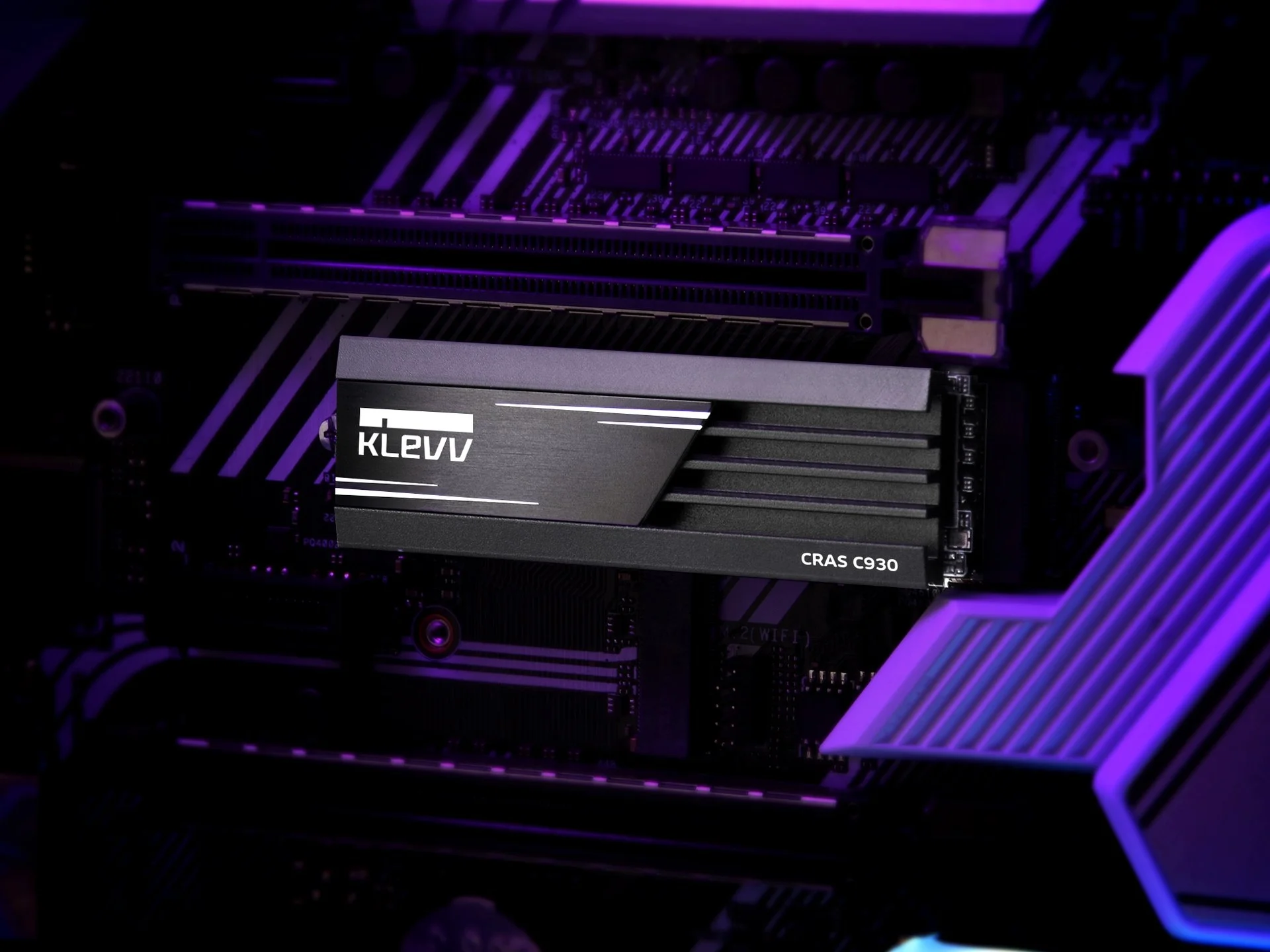
The CRAS C930 is the model to look at if performance is the main consideration.
It uses a PCIe Gen4 x4 interface with the NVMe 1.4 specification and is capable of sequential read speeds of up to 7,400 MB/s. The 1TB model reaches up to 6,400 MB/s sequential write speed, while the 2TB version goes up to 6,800 MB/s. Both capacities are rated at up to 1,000K IOPS for 4K random read and write performance.
One of the main differences between the C930 and the other two models is its DRAM cache buffer. The dedicated DRAM provides a high-speed buffer for the SSD, which can help improve overall read and write performance while contributing to the drive’s durability.
The C930 also supports intelligent SLC caching, LDPC ECC, global wear leveling, and AES 256-bit hardware-based encryption. These features are aimed at maintaining performance and data integrity over extended use.
Cooling is handled differently from the increasingly common fixed heatsink approach. The C930 comes with an attachable flat-fin aluminium heatsink, allowing users to decide whether they want to use it depending on their motherboard and cooling setup.
KLEVV claims that the heatsink can reduce temperatures by up to 20% compared with running the SSD without a heatsink. This flexibility can be useful for users whose motherboard already has an M.2 heatsink, while those who need additional cooling can use the included solution instead.
The C930 is available in 1TB and 2TB capacities, with endurance ratings of 750TBW and 1,500TBW respectively. It is also designed to work with the PlayStation 5 expansion slot, making it an option for users looking to expand their console storage.
For someone putting together a performance-oriented gaming PC or workstation and specifically looking for a higher-end PCIe Gen4 SSD, the C930 is the most performance-focused option within this trio.
KLEVV CRAS C925G: High Speed Without a Bulky Heatsink


Not every system has plenty of space around its M.2 slots. This becomes particularly relevant in compact PCs, laptops and systems where the SSD sits underneath a motherboard heatsink or graphics card.
This is where the CRAS C925G takes a different approach.
The C925G still offers up to 7,400 MB/s sequential read performance, with sequential write speeds reaching up to 6,200 MB/s for the 500GB model, 6,300 MB/s for the 1TB model and 6,500 MB/s for the 2TB model. The 2TB version is also rated for up to 700K IOPS read and 1,000K IOPS write performance.
What makes the C925G more interesting is its graphene-copper composite heatsink.
Instead of using a relatively thick aluminium heatsink, KLEVV uses a slim thermal solution designed to transfer heat away from the SSD while keeping the overall profile low. The current C925G is available in a single-sided design with a very thin heatsink, which gives it greater flexibility when installed in systems with limited clearance.
This makes the C925G a particularly practical option for users who want high PCIe Gen4 performance but do not want a large heatsink interfering with the rest of their system.
The drive is available in 500GB, 1TB, and 2TB capacities, with endurance ratings of 600TBW, 1,200TBW, and 2,400TBW respectively.
For a gaming PC, content creation machine, or compact system where both speed and physical compatibility matter, the C925G offers a good balance within KLEVV’s current Gen4 range.
KLEVV CRAS C910G: When Storage Capacity Matters More


Then there is the CRAS C910G, which takes a more capacity-oriented approach.
It may not reach the same sequential performance figures as the C930 or C925G, but it still provides respectable PCIe Gen4 performance with sequential read speeds of up to 5,200 MB/s and sequential write speeds of up to 4,800 MB/s on the higher-capacity models.
The C910G is available in 500GB, 1TB, 2TB and 4TB capacities. The 4TB model is rated at up to 2,800TBW endurance, which gives users a considerable amount of storage for large game libraries, applications, high-resolution media and other data-heavy workloads.
Like the C925G, the C910G uses a graphene-copper composite heatsink. Its slim 0.26mm heatsink design allows the drive to fit into a wider range of systems, including desktops, mini PCs and laptops where M.2 clearance can sometimes be an issue.
The C910G also includes features such as intelligent SLC caching, S.M.A.R.T. monitoring, LDPC ECC, global wear leveling, and AES 256-bit hardware encryption. KLEVV also provides an activation key for Acronis True Image for data migration and backup.
For users who are constantly running out of storage space, the 4TB option is arguably the most interesting part of the C910G lineup. Having more capacity can be more useful in everyday use than chasing the highest sequential benchmark numbers, especially for systems that are used to store large game libraries, video projects, and other sizeable files.
Which KLEVV SSD Makes Sense for You?


The three drives are ultimately aimed at slightly different priorities.
The CRAS C930 is the obvious choice within this group if performance is the primary concern. Its DRAM cache, up to 7,400 MB/s read speed and up to 6,800 MB/s write speed on the 2TB model make it the most performance-oriented option.
The CRAS C925G takes a more balanced approach. It combines high-end PCIe Gen4 performance with a very slim graphene-copper thermal solution, making it particularly suitable for compact systems and builds where M.2 clearance is important.
The CRAS C910G is the more capacity-focused option. Its performance is still more than sufficient for gaming, productivity, and everyday workloads, while the availability of a 4TB model gives users considerably more room for their applications, games, and files.
This also highlights why PCIe Gen4 SSDs continue to make sense for many users. Not everyone needs to chase the latest storage interface, particularly when their workload is primarily gaming, office work, content consumption, or general desktop use. A good PCIe Gen4 SSD can still provide fast system responsiveness, quick game loading, and high-speed file transfers without requiring a complete move to a newer platform.
KLEVV’s Current Gen4 Storage Options
Rather than treating the CRAS C930, C925G and C910G as products competing for the same audience, KLEVV’s lineup gives users several ways to approach a PCIe Gen4 upgrade.
Those looking for higher performance can go with the C930 and its DRAM cache. Users building compact systems or looking for a slim thermal solution can consider the C925G, while those who simply need more storage can opt for the C910G, with capacities reaching up to 4TB.
All three drives are already part of KLEVV’s storage lineup and remain relevant for users planning a new build or upgrading an existing system. KLEVV also provides Acronis True Image support for its SSD range, giving users an additional option for migrating an existing installation or backing up their data.
For users who are still running an older SATA SSD or hard drive, moving to one of these PCIe Gen4 drives can be a straightforward way to give an existing system a storage performance boost without necessarily having to move to a completely new storage platform.


