When hardware enthusiasts think of Noctua, most would immediately picture their air coolers, industrial-grade engineering, and of course, the iconic brown-and-beige colour scheme. The company has built a strong reputation around air cooling over the years, with products such as the NH-D15 and later the NH-D15 G2 becoming a familiar choice among enthusiasts who prioritise cooling performance and low noise.
However, Noctua has been showing increasing interest in liquid cooling in recent years. The company first teased its progress in this area during COMPUTEX 2025, giving us an early look at what would eventually become its first all-in-one liquid cooler. A year later at COMPUTEX 2026, Noctua finally presented the finished product, the Noctua NL-LC1-36, ready for the retail market.
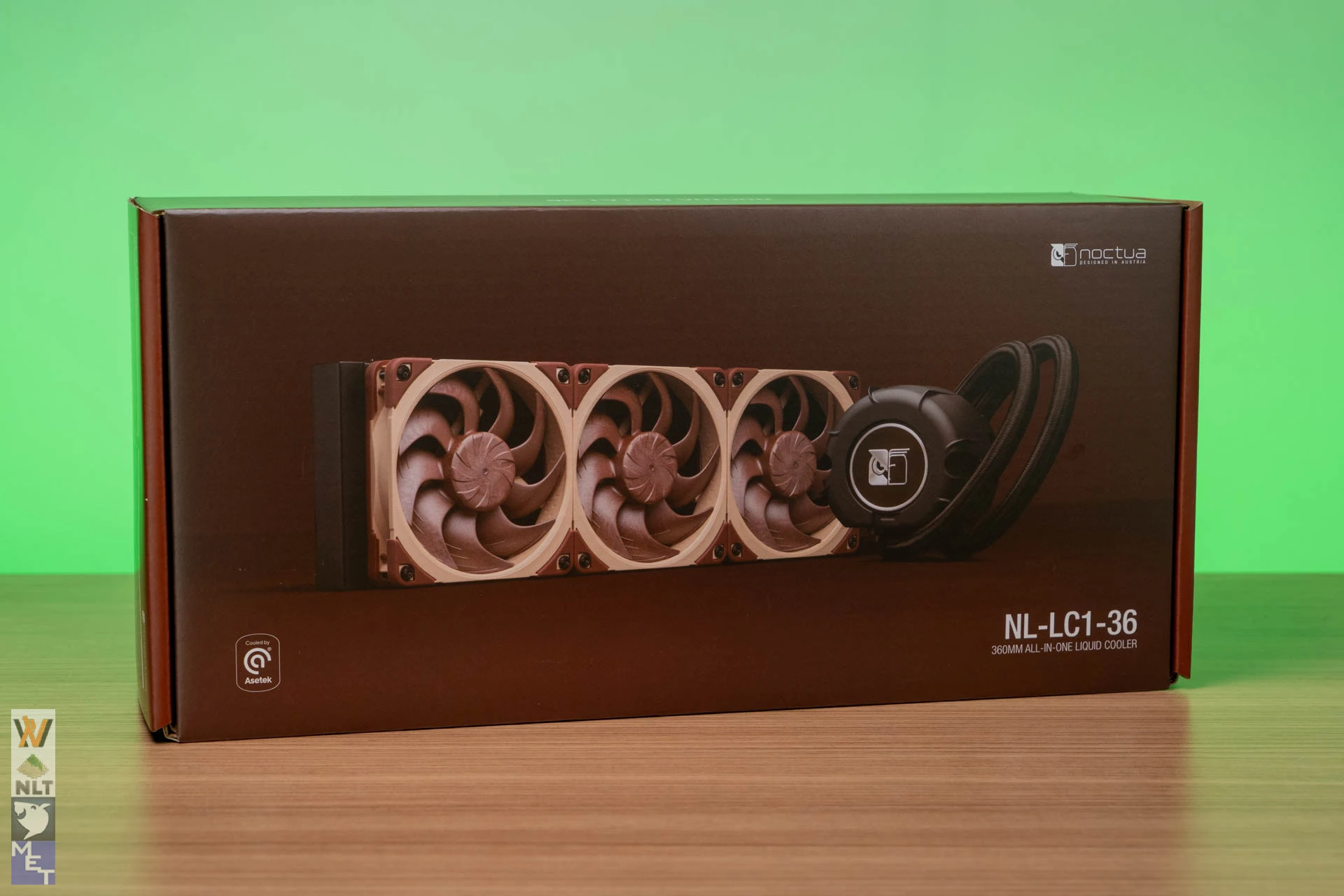
Rather than simply taking an existing AIO platform and putting its own fans on it as many brands do, Noctua has taken a more familiar approach by applying its own engineering philosophy to the areas it believes matter most, particularly fan performance, pump noise and vibration control.
On paper, it sounds like a very Noctua approach to an AIO cooler. The more interesting question, however, is whether all of this engineering translates into better performance in actual use.
A Carefully Packed First Impression


Opening the NL-LC1-36 gives a fairly typical Noctua first impression. The packaging is neat and organized, with the components arranged in dedicated cardboard compartments rather than being thrown into a large box with excessive plastic packaging.


Three of Noctua’s flagship NF-A12x25 G2 120mm PWM fans are included for the 360mm radiator of the NL-LC1-36. These are the company’s latest flagship 120mm fans, using Sterrox liquid-crystal polymer construction and a very tight tip clearance to improve airflow efficiency.
More importantly for an AIO, the fans are designed to produce high static pressure, making them suitable for pushing air through the relatively dense fins of a radiator while keeping noise under control.
The three fans are obviously one of the major contributors to the overall cost of the NL-LC1-36, but they also make sense from a performance perspective. Noctua is not treating the fans as an afterthought here.
They are an integral part of the cooling system, and having three NF-A12x25 G2 fans included means there is no need to immediately replace the stock fans with another set of high-end models.


The pump assembly is where Noctua’s approach becomes more interesting. Instead of simply relying on the pump housing and rubber mounting to deal with vibration, the NL-LC1-36 incorporates a tuned-mass damper inside the pump block. The damper is calibrated to absorb vibration generated around the pump motor and reduce the amount of vibration transferred into the rest of the system.
Noctua has also implemented a three-layer soundproofing structure around the internal pump assembly. Together, these measures are intended to address one of the more difficult aspects of liquid cooling: pump noise.
AIO pumps are generally much quieter than they used to be, but they are still a mechanical component running continuously whenever the system is operating. Even when the radiator fans are relatively quiet, pump whine or mechanical resonance can become noticeable in an otherwise quiet system.
Noctua’s solution is therefore less about making the pump completely silent and more about controlling the type of noise it produces.

This is different from some competing AIO coolers that arrive with a layer of thermal compound already applied to the CPU block. Instead, Noctua leaves it clean and includes its own premium thermal compound and leaves the application to the user.
There is a practical reason for this. Different users have different preferences when it comes to thermal paste application, whether it is a small central dot, a cross pattern or another method. Leaving the cold plate clean also means users who need to reinstall the cooler later can clean the surface and apply fresh thermal compound without having to deal with a partially used pre-applied layer.
It is a small detail, but it fits with Noctua’s general approach to its products. The company gives users the components they need while leaving certain installation decisions in their hands.


Another interesting accessory is the optional NL-ACF1 auxiliary fan, which is sold separately. The small fan attaches magnetically to the pump block and is designed to provide additional airflow around the CPU socket area, particularly over the VRM and memory area.
At first glance, this might seem like something that would require a bit of experimentation to determine the best position. Noctua, however, has already determined the intended orientation and angle of the fan, so users do not need to spend time trying different positions to figure out where it works best.


The NL-ACF1 is not essential for the cooler to function, but it is an interesting addition for users who want some additional airflow around the motherboard’s CPU socket area, particularly in a system where the primary CPU cooling is handled entirely by the radiator.

Despite the features packed into the pump assembly, the NL-LC1-36 keeps the pump surprisingly compact, with minimal cabling and none of the bulky lighting or display modules found on many high-end AIOs.
This makes cable management and installation much easier, while Noctua’s SecuFirm2+ mounting system keeps the installation straightforward. The simpler design also makes future maintenance or component upgrades less troublesome, which is one of the more practical advantages of the NL-LC1-36.
Thermal Performance
For our testing, the Noctua NL-LC1-36 was compared against several 360mm AIO liquid coolers, including the TRYX HOLO, TRYX Stage, TRYX Panorama 360 ARGB, Valkyrie A360, DeepCool LM360 WH, ROG Ryuo III 360 ARGB and Cooler Master MasterLiquid ION 360.
The cooler was tested with both the Intel Core Ultra 9 285K and AMD Ryzen 9 9950X to see how it performs across different platforms and CPU workloads.
The results were quite impressive. The NL-LC1-36 came out on top in both sets of testing, maintaining lower average and peak temperatures than the other 360mm coolers in the comparison.
Intel Core Ultra 9 285K (250W)

| 360mm AIO Cooler | Average Load | Peak | Idle |
|---|---|---|---|
| Noctua NL-LC1-36 | 76°C | 82°C | 40°C |
| TRYX Panorama 360 ARGB | 78°C | 83°C | 40°C |
| TRYX HOLO | 84°C | 89°C | 40°C |
| TRYX Stage | 84°C | 91°C | 40°C |
| Valkyrie A360 | 85°C | 94°C | 40°C |
| Cooler Master MasterLiquid ION 360 | 86°C | 94°C | 40°C |
| DeepCool LM360 WH | 88°C | 95°C | 40°C |
| ROG Ryuo III 360 ARGB | 89°C | 96°C | 41°C |
On the Core Ultra 9 285K, the NL-LC1-36 recorded an average load temperature of 76°C, with a peak temperature of 81°C and an idle temperature of 40°C. The closest result came from the TRYX Panorama 360 ARGB, which recorded 78°C average and 83°C peak temperatures. This gives the Noctua cooler a 2°C advantage in both average and peak temperatures.
The difference becomes more noticeable when looking further down the chart. Some of the other coolers reached peak temperatures of 94°C to 96°C, putting the NL-LC1-36 as much as 15°C below the hottest result in this particular test.
What is particularly interesting here is that the NL-LC1-36 manages to achieve this without relying on aggressive fan or pump behaviour. The cooling performance is strong, but the overall acoustic character remains relatively restrained.
AMD Ryzen 9 9950X (230W)

| 360mm AIO Cooler | Average Load | Peak | Idle |
|---|---|---|---|
| Noctua NL-LC1-36 | 76°C | 84°C | 49°C |
| TRYX Panorama 360 ARGB | 78°C | 86°C | 48°C |
| TRYX HOLO | 82°C | 88°C | 52°C |
| TRYX Stage | 83°C | 88°C | 51°C |
| Valkyrie A360 | 84°C | 92°C | 54°C |
| Cooler Master MasterLiquid ION 360 | 85°C | 90°C | 52°C |
| DeepCool LM360 WH | 86°C | 91°C | 53°C |
| ROG Ryuo III 360 ARGB | 84°C | 90°C | 52°C |
The results were equally impressive with the Ryzen 9 9950X. The NL-LC1-36 recorded an average load temperature of 76°C and a peak of 84°C, while idle temperature remained at 49°C. Once again, the TRYX Panorama 360 ARGB was the closest competitor at 78°C average and 86°C peak. The remaining coolers in the comparison ranged from 82°C to 86°C average load temperatures, with peak temperatures reaching as high as 92°C.
The consistency across both platforms is perhaps more important than the absolute numbers themselves. Whether paired with Intel’s Core Ultra 9 285K or AMD’s Ryzen 9 9950X, the NL-LC1-36 remained at the top of the comparison. That gives some confidence that its performance is not simply the result of favouring one particular CPU platform or workload.
The NL-LC1-36 also performs well in terms of acoustics, with its pump remaining relatively quiet even under heavy CPU workloads. It is not completely silent at 100% duty, but the tuned-mass damper and three-layer soundproofing help reduce vibration and mechanical noise, resulting in a smoother and less intrusive pump sound compared with most of the AIOs we have tested.
Combined with the NF-A12x25 G2 fans, the NL-LC1-36 manages to deliver strong cooling performance without becoming noticeably noisy during sustained workloads, making it a good fit for users who prioritise a quieter system.
Note: Results were recorded using Noctua NT-H2 thermal compound. Keep in mind that different thermal pastes and application techniques may yield slightly different thermal results.
Final Thoughts
It may not be the most visually exciting option on the market, and users looking for RGB lighting or an integrated LCD display will find plenty of other AIOs that offer more in terms of features. But the Noctua NL-LC1-36 is clearly designed with a different priority in mind: strong cooling performance, quiet operation and a clean, straightforward installation.
At RM1,495, the NL-LC1-36 is undeniably an expensive 360mm AIO liquid cooler. There are plenty of more affordable options available, including models with RGB lighting, integrated displays and other features that the Noctua does not offer. At this price point, however, what matters is whether the performance and overall experience can justify the premium.
Based on our testing, the NL-LC1-36 makes a strong case for itself. It recorded the lowest average and peak temperatures in our comparison with both the Core Ultra 9 285K and Ryzen 9 9950X, while its pump also remained noticeably quieter and smoother than most of the other AIOs we have tested.
That combination of cooling performance and acoustic behaviour is ultimately what sets the NL-LC1-36 apart. It does not try to win users over with an elaborate pump block or a long list of extra features. Instead, it focuses on doing the fundamentals exceptionally well, while keeping the installation and overall setup relatively straightforward.
At this price, expectations are naturally high, but the NL-LC1-36 has the performance to justify its position as a premium AIO. If cooling performance, low noise and long-term practicality matter more to you than RGB lighting or an integrated display, the Noctua NL-LC1-36 is easily one of the best 360mm AIO liquid coolers we have tested so far.