

When Lian Li first introduced the UNI FAN series, it introduces a new custom PC building approach. By replacing individual, messy cable runs with modular interconnects, the company set a new benchmark for chassis aesthetics and cable management. With the UNI FAN CL Flex 120, Lian Li refines that formula once again, introducing their upgraded FLEX platform alongside clean presentation and flexible control options.
Having spent quality time hands-on with both the Standard Blade and Reverse Blade models in a real-world system layout, here is how these premium 120mm fans hold up from a builder’s perspective—focusing on unboxing, mechanical installation, ecosystem compatibility, lighting execution, and day-to-day acoustics.
Unboxing and Ecosystem Flexibility

Right out of the box, the CL Flex 120 set feels deliberate and complete. Lian Li packages each unit (or multi-pack cluster) with everything required to integrate the fans into either a proprietary control setup or a standard motherboard layout.


Inside, you will find the fans themselves, the snap-on FLEX Receiver module, fan mounting hardware, standard 4-pin PWM and 5V 3-pin ARGB motherboard cables, and power delivery adapters.
Rather than forcing builders into a closed hardware loop, Lian Li provides the wiring versatility to run these fans directly off your motherboard’s native headers, connect them to the new L-Wireless controller ecosystem, or route them through dedicated L-Connect setups. This flexibility ensures that upgrading your cooling layout does not require overhauling your entire system architecture.
Mechanical Installation & The New FLEX Interlocking System


The hallmark of the UNI FAN series has always been its physical daisy-chaining mechanism, and the CL Flex 120 handles this seamlessly. Individual fan units slide together and interlock with a reassuring physical click, converting up to four individual 120mm fans into a single, rigid structural cluster.
Understanding the FLEX Mechanism & Cross-Compatibility
If you are upgrading from older Lian Li fan families (such as the original SL120 V1/V2, AL120, or non-FLEX SL-Infinity lines), it is important to note that the CL Flex 120 utilizes Lian Li’s upgraded FLEX platform.
- Within the FLEX Lineup: The interlocking tracks, pin configurations, and snap-on receivers are 100% shared across the FLEX ecosystem. Standard Blade and Reverse Blade models use identical interlocking mechanisms and can even be interlocked together within the same physical cluster. The snap-on FLEX Receiver attaches to either end of any FLEX-series cluster regardless of blade orientation.
- Legacy Generation Compatibility: Because Lian Li updated the rail tracks and pin alignment for the FLEX platform, CL Flex 120 fans cannot physically interlock directly with older legacy generations (like the SL120 V1 or AL series), nor do they plug directly into older legacy UNI HUB controllers.
Cable Routing & Dimensions

The real convenience of the design becomes apparent during cable routing. Instead of wrestling with six to eight individual PWM and ARGB wires for a top-mounted 360mm radiator, the entire array communicates through a single FLEX receiver module attached to the end of the cluster. This drastically reduces hub clutter behind the motherboard tray and simplifies cable management.
It is worth noting the physical dimensions: the CL Flex 120 frame measures 28mm in thickness, compared to the conventional 25mm standard. While this extra 3mm is rarely an issue in standard mid-tower and full-tower ATX chassis, builders working inside compact Small Form Factor (SFF) enclosures or tight radiator-push-pull setups should carefully verify clearance near memory modules and motherboard heatsinks.
Software Experience and Control Options


System control is handled primarily through Lian Li’s L-Connect 3 software suite, which allows for detailed custom fan curves, synchronized dynamic lighting schemes, and independent control of the blade and side-frame lighting zones. The software interface allows you to map and name fan clusters according to their physical position inside your chassis, making speed and lighting adjustments intuitive.
Importantly, if you prefer to minimize the background software footprint on your system, Lian Li does not lock you into L-Connect 3. Connecting the FLEX receiver directly to standard motherboard PWM and 3-pin ARGB headers grants full speed and lighting control through your motherboard vendor’s native BIOS or software suite.

The lighting implementation features dual-zone addressable RGB diffusers split between the main fan blades and subtle side frame accents. The light diffusion is remarkably smooth, masking individual LED hot-spots and producing a soft, saturated glow. Brushed aluminum-style trim along the side edges adds a refined texture that elevates the overall aesthetic even when the lighting is turned off.
Everyday Acoustics and Sound Profile
Without getting bogged down in synthetic wind-tunnel telemetry or acoustic chamber readings, the real-world noise profile of the CL Flex 120 series is tuned comfortably for daily desktop use.
At low-to-moderate workloads (under ~1,200 RPM), the fans are virtually silent within a closed glass case. Air movement is imperceptible over typical ambient room noise, making them ideal for quiet working environments or extended browsing sessions.
When pushed higher up the duty cycle (above 1,500 RPM) during heavy CPU and GPU loads, the sound signature leans toward a low-frequency, smooth rushing air sound rather than an annoying high-pitched motor whine or turbulence hum. The Reverse Blade model exhibits a slightly different pitch at maximum RPM due to its altered blade curvature, but inside a fully assembled case, the acoustic difference between standard and reverse units is practically negligible. A custom fan curve set in software keeps them quiet under almost all standard gaming loads.
The Final Verdict
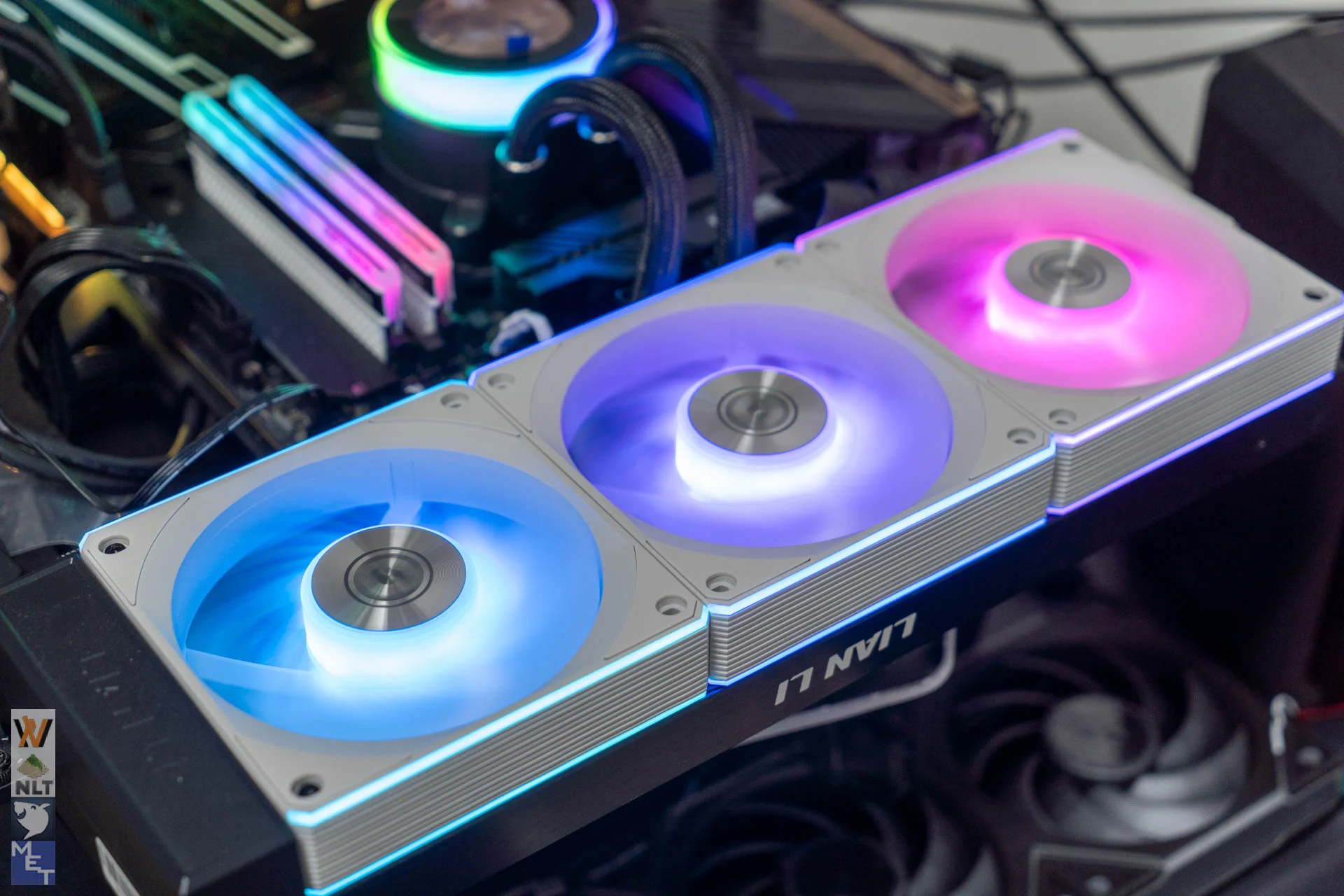
The Lian Li UNI FAN CL Flex 120 standard and reverse blade fans excel at what matters most in custom PC building: effortless assembly, superior cable management, and exceptional visual consistency. By offering matching reverse-blade models on a shared FLEX platform, Lian Li allows builders to maintain a flawless aesthetic across both intake and exhaust positions without compromising on build quality or ease of installation.
While existing owners of older legacy UNI FANs should keep in mind that the new FLEX interlock mechanism and receiver require the FLEX ecosystem, the overall user experience—from unboxing and physical mounting to wireless hardware options and daily acoustic comfort—makes the CL Flex 120 an outstanding choice for any modern showcase build.


