At the Open Compute Project (OCP) Global Summit, Intel shared new technical details on the Intel GPU D-series (formerly code-named Crescent Island), introduced new Xeon-based rack designs, and highlighted open software and ecosystem work. The thread running through all of it is Intel’s argument for open, heterogeneous AI infrastructure that combines CPUs, GPUs, and specialised accelerators, with open software tying them together.
The reasoning starts with agentic AI turning inference into a multi-step workflow of retrieval, reasoning, orchestration, tool use, and execution. In that picture, x86 CPUs play a central role, and scaling becomes a systems challenge shaped by power limits, memory bottlenecks, and cost.

First, we have the new D-series GPU, made based on the Intel Xe3P architecture and designed for sustained, memory-intensive inference.
| Spec | Details |
|---|---|
| Memory | Up to 480GB LPDDR5X |
| Memory bandwidth | 1.5 TB/s |
| Compute | 1.3 petaflops FP8 |
| Power | 350W |
| Model capacity | Up to 300B parameters on one card, over 1 trillion in an eight-GPU system |
| Form factor | Standard PCIe, air-cooled |

It targets LLMs, long-context workloads, and concurrent inference services, from multi-tenant AI to robotics and other latency-sensitive uses. The standard PCIe, air-cooled design is meant to fit existing data centers without specialised rack or cooling infrastructure. Customer sampling is underway, and Intel is working with OEMs, ODMs, neoclouds, software vendors, and AI-native companies on validated platforms.
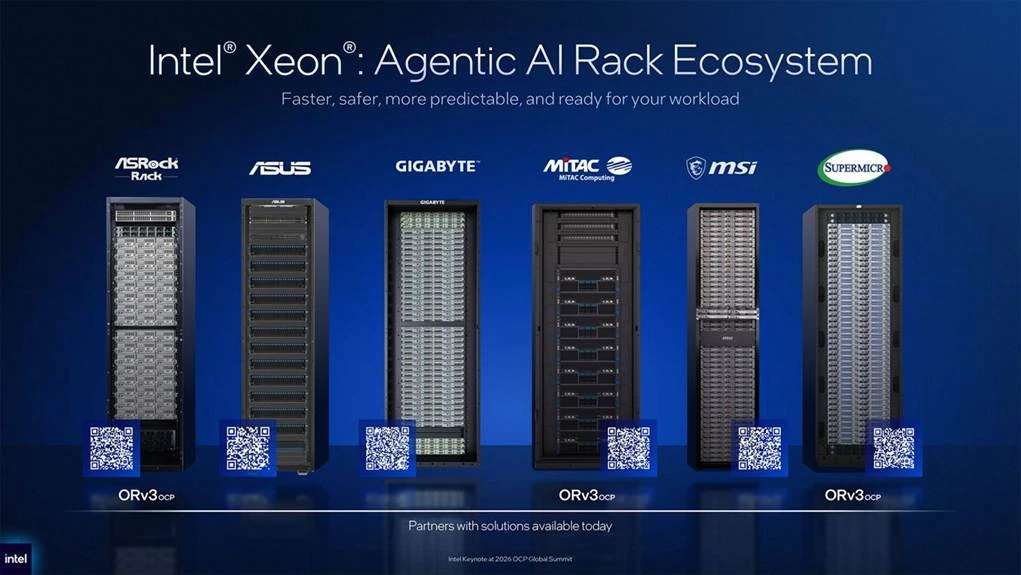
Meanwhile, Xeon racks built on the OCP Open Rack V3 standard have been shown too. Select Xeon 6+ configurations scale beyond 46,000 cores per rack at 133.45 kW total rack power. Intel’s view is that Xeon handles orchestration, data processing, I/O, and task execution to keep accelerators productive, and that performance will increasingly be measured by how many concurrent agents a rack can sustain at target latency.
Team Blue is also opening up its ecosystem by embracing software and infrastructure openness:
- Portability: A common Xe software foundation lets developers reuse applications across Intel GPU platforms.
- Frameworks: Upstream support for industry-standard AI frameworks, serving engines, and tools across both CPUs and GPUs.
- Day 0 model support: Including Day 0 support for Meta’s Muse Glimmer.
- Agent toolkit: The Intel AI for Enterprise Agent Toolkit is deployable on Xeon now, with a provider-based design meant to extend to Intel GPUs.
- OCP contributions: Intel has made 116 contributions since 2011, and this year it is showcasing its work in the Open Adapter Card workgroup on a standardised sub-rack accelerator card form factor.