The convergence of government backing, international trade heavyweights, and local technical talent is reshaping how Southeast Asia approaches industrial transformation. At the newly expanded Selangor Techsphere Summit (STS) 2026 at the Kuala Lumpur Convention Centre, the dialogue has shifted firmly away from experimental tech buzzwords toward deep, pragmatic execution.
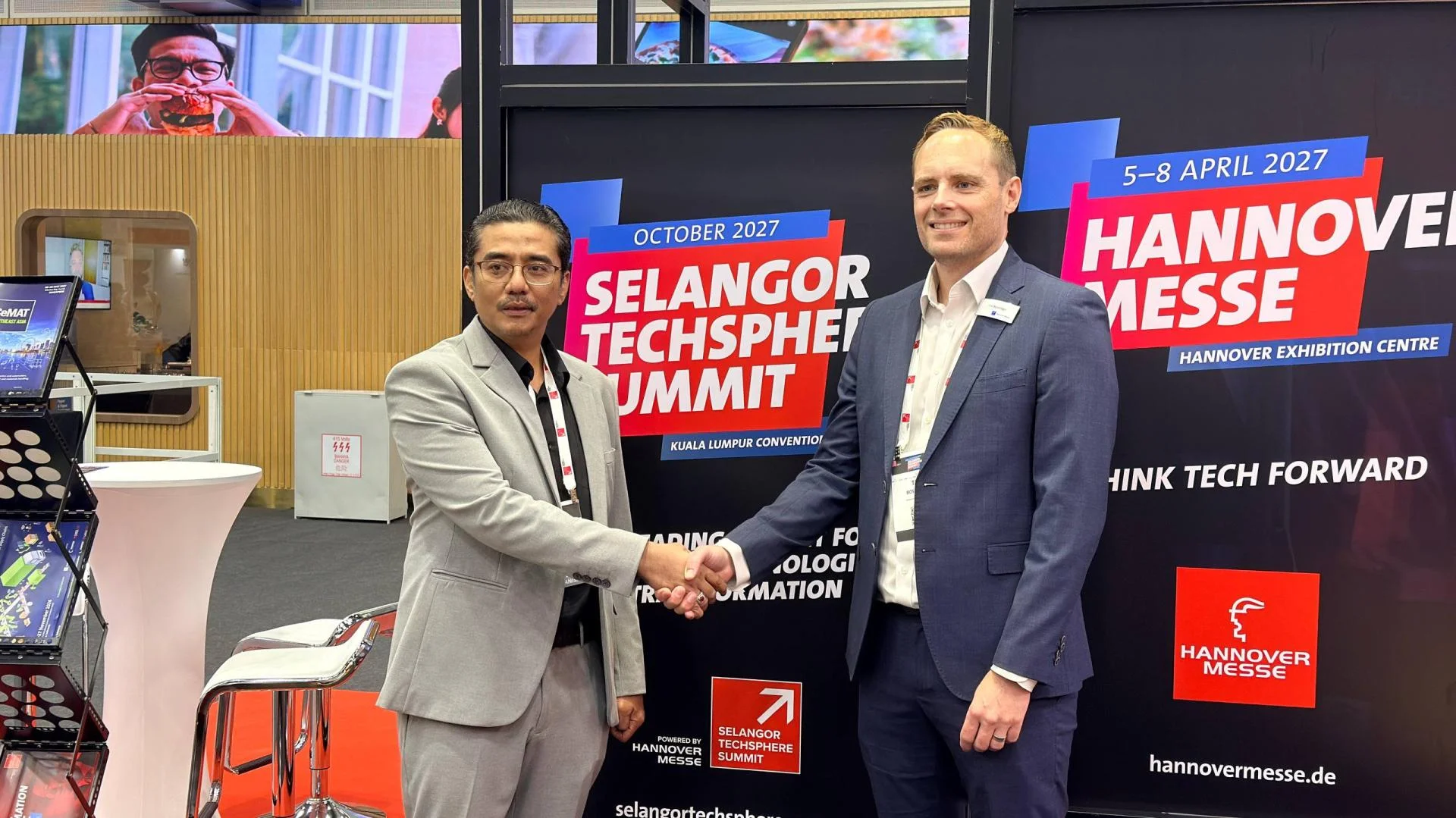
To understand the macro forces driving this shift, we sat down for an exclusive conversation with Tim Bostridge, Managing Director of Hannover Fairs Asia Pacific. From expanding alongside the Selangor International Business Summit (SIBS) to navigating the mounting economic pressures of AI infrastructure, Bostridge shares his insights on what it takes to future-proof regional manufacturing.
Expanding the Scope: From Two Days to Four
Q: May I know the highlights that distinguish this year’s edition from previous iterations?
Tim Bostridge: This year we’re delighted, obviously, to be part of the wider Selangor International Business Summit, which is the first time that we’ve done that. So the program’s now expanded over four days rather than two days that we were last year.
We’re looking each day into specific themes, such as industrial AI, green technology, and human capital. So we’re really deep-diving each day into core topics that are important to the future growth of industry in Malaysia and Selangor.
Bringing Hannover Messe’s Global Playbook to Local Ecosystems
Q: For our readers interested in the macro growth of global trade organizers, how does Deutsche Messe deploy a giant brand like Hannover Messe into regional expos like STS?
Tim Bostridge: Deutsche Messe, obviously, we’re a global event organizer. We run a number of events around the world, but I guess the biggest brand that we have is Hannover Messe, which is the big industrial trade fair taking place every year in Hanover.
We run events in strategic locations where industry is really being transformed. At the moment, I think Malaysia and Selangor are key components of that change. And so it’s really taking the themes and topics coming from a leading trade fair like the one in Germany and bringing them here, looking at them in a local context, and understanding how they apply to local businesses and what local businesses can do to really take their own productivity forward.
Q: Given that this expo is currently anchored in Selangor, do you see potential to bring similar themed expos to other Malaysian states like Penang or Johor?
Tim Bostridge: We certainly welcome people from those states to Selangor for this event. We also run another program in Singapore, which is obviously very close to Johor. So I think it’s not something that I see moving around necessarily. I think we’re very focused here in Kuala Lumpur and in Selangor.
But there are a lot of other programs and relevance to other states and companies from other regions to be here as well. So we try and make it as all-encompassing as we can, both nationally, regionally, and internationally. But I think this one will be here in Selangor for the foreseeable future.
Navigating Global Investment and AI Infrastructure
Q: What are international investors looking for when choosing where to invest in technology, and what areas still need improvement globally?
Tim Bostridge: I don’t want to comment on specific areas that governments need to work on. I think that all countries around the world at the moment are looking at ways they can improve their policy settings and their infrastructure to welcome businesses and welcome investment into their regions.
The world is changing, as our keynote speaker is talking about at the moment, in many ways that we’ve not seen in the past decade. Malaysia is on a great path in terms of being a viable and interesting destination for a number of businesses internationally, and is also doing a great job of growing its own domestic businesses as well. Domestic capability, as well as having a good standing internationally, is going to be critical going forward.
Q: How do you see AI expansion and disruption evolving within the semiconductor industry compared to previous editions?
Tim Bostridge: It’s a huge growth industry, obviously, around the world, but also here in Malaysia. I think AI is going to play a central role in all processes moving forward, whether it’s fairly basic automation or genuine artificial intelligence, which is where everything is moving towards.
We don’t necessarily have the human capital to achieve the scales of economy needed, and technology allows us to get to where we need to get to faster. So it will absolutely play a big role going forward.
Balancing the Rising Costs of AI Hardware
Q: With the continuous rising costs of memory and electronic parts for AI growth, especially with manufacturers like Micron, SK Hynix, and Samsung driving supply, how can businesses navigate these cost hurdles?
Tim Bostridge: Inflation and rising costs, particularly in that area, are going to be a real challenge. Demand is only going to increase. Those companies are obviously working on improving and increasing their supply chain to manage those impacts, but the impact of that is very real all the way across every type of electronic device, and prices are being pushed upward as a result.
The market has a way of finding the balance between supply and demand. As costs go up, maybe we have to slow down a little bit, or maybe companies are finding new ways to create the technology they need to move forward. It’s definitely going to be a factor.
Looking Forward: Green Tech, Data Centres, and Space Tech
Q: Looking at generational leaps, akin to the initial introduction of smartphones or ChatGPT, what breakthrough products or services do you foresee emerging in the near future?
Tim Bostridge: From the context of Hannover Messe, some of the newer areas that it’s focusing on are green technology and creating the energy that we need to power this future. Obviously, looking at data centre infrastructure and creating the capacity that we’re going to need for powering this future.
And a new area that we’re starting to focus on in 2027 is also looking at some of the space technology and tech that’s going to be used in that industry in the future. I think that’s a very interesting area that perhaps we don’t really fully understand the potential of just yet, but products will be emerging over the next few years that I think we’re not even imagining at the moment.