

Walking through the floor at the Taiwan Smart Solutions Connect 2026, it’s easy to get distracted by flashy displays and sleek industrial robots. But for most manufacturers, the real “monster under the bed” isn’t hardware, it’s the loss of human expertise.

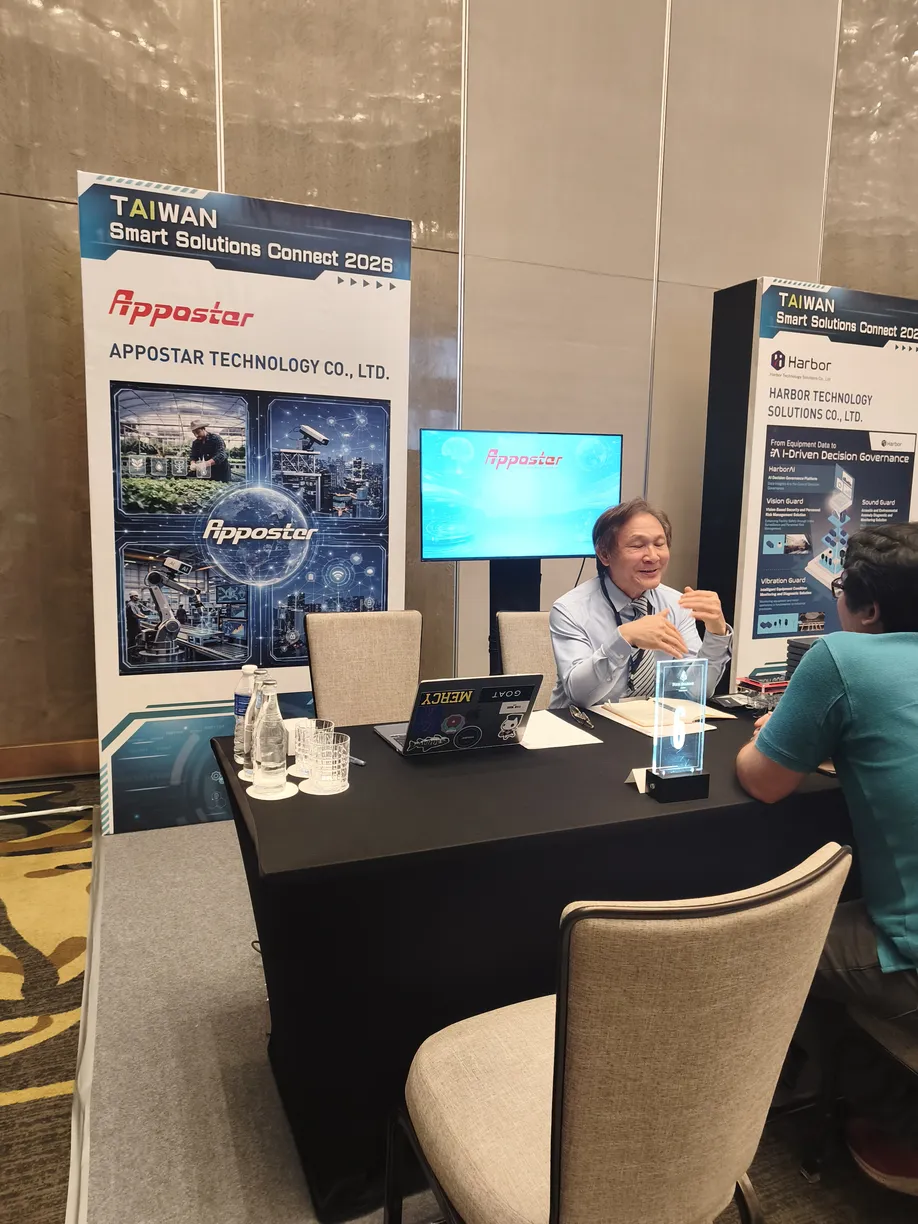
I had the chance to sit down for a 1-to-1 with Mr. Nick Lu, Vice President of Appostar Technology Co., Ltd. While the company built its reputation on high-performance POS systems and industrial PCs, they’ve recently pivoted into a space that is arguably much more critical: AI-driven Digital Twins and specialized model training.
Here is what Nick had to share about Appostar’s mission in Malaysia and the broader manufacturing landscape.
The Knowledge Gap: Turning Expertise into an “Unmovable Asset”
Tech Critter: Appostar leverages AI model training and digital twin technologies to solve one of manufacturing’s biggest challenges – knowledge transfer. Could you share a real-world example of how AI helped preserve and replicate the expertise of experienced operators?
Nick Lu: Knowledge transfer is a challenge for the entire world, not just Malaysia. We see it everywhere: skilled engineers and operators spend decades getting really, really good at what they do. But as soon as they retire or move on, they take those “magic hands” and specialized skills with them. The company then has to sink time and money into retraining a whole new group from scratch.
This is exactly where we step in. We work with clients to train a specialized AI alongside their veteran operators. Think of it as “downloading” the logic and experience of your best engineer. As more data is fed in, the AI gets sharper over the years.
More importantly, it becomes an unmovable asset of the company. A new staff member doesn’t need ten years of experience to get started; they just need an introduction to the AI. You can then replicate that “expertise” across ten different branches with minimal effort. You aren’t just hiring a person anymore; you’re deploying a perfected system.
The ROI Reality Check: Can SMEs Afford AI?
Tech Critter: Many SMEs are interested in AI adoption, but implementation cost and ROI remain major concerns. Can you share measurable results from actual deployments, such as productivity improvements or ROI timelines?
Nick Lu: If you only look at the surface, the initial setup cost can definitely be a deterrent. For first-timers, the “sticker shock” is real. But it’s a classic case of looking at the long game.
Why is it worth it? Because once you implement these AI mini-servers and modules, you aren’t just “automating” – you’re fundamentally speeding up the process and eliminating human error. In manufacturing, even a 1% reduction in errors can translate to massive savings.
We’ve seen clients reach their ROI timeline in as little as a year. When you factor in the reduction in operational costs and the fact that you no longer have to pay the “retraining tax” every time a staff member leaves, the math starts to make a lot of sense very quickly.

Our Takeaway: Why Appostar Matters for Malaysia
Appostar isn’t just selling “AI boxes”; they are selling Continuity. For Malaysian SMEs currently struggling with labor shortages or high turnover rates, the idea of turning a senior engineer’s brain into a permanent company asset is a genuine “life hack” for industrial growth.
By utilizing their AI Mini Servers and Endpoint AI Modules, Appostar is effectively lowering the barrier for local factories to go from “analog” to “autonomous.” It’s no longer about just having the best machines; it’s about making sure the “soul” of the operation stays in the building, no matter who walks out the door.


