AMD has revealed more information about the Ryzen AI Max+ 395 mobile processor.
This new APU is equipped with “Zen 5” cores and delivers over 50 AI TOPS thanks to the XDNA 2 NPU. It also packs the Radeon 8060S integrated GPU, featuring 40 RDNA 3.5-based Compute Units, promising impressive laptop performance. Supporting up to 128GB of unified memory, the system allows up to 96GB of that to be allocated as VRAM through Variable Graphics Memory technology.
These specs translate to remarkable performance in AI tasks, particularly in applications like LM Studio. In benchmarks, it outperformed competitors — notably surpassing the Intel Core Ultra 7 258V (though not comparing to the Ultra 9 series) — achieving up to 2.2 times faster token throughput and 12.2 times better time-to-first-token in large language model processing. AMD highlighted that for models like IBM’s Granite Vision and Google’s Gemma 3, performance is around 7x faster. A fully equipped system with this processor can comfortably run the Gemma 3 27B Vision model.

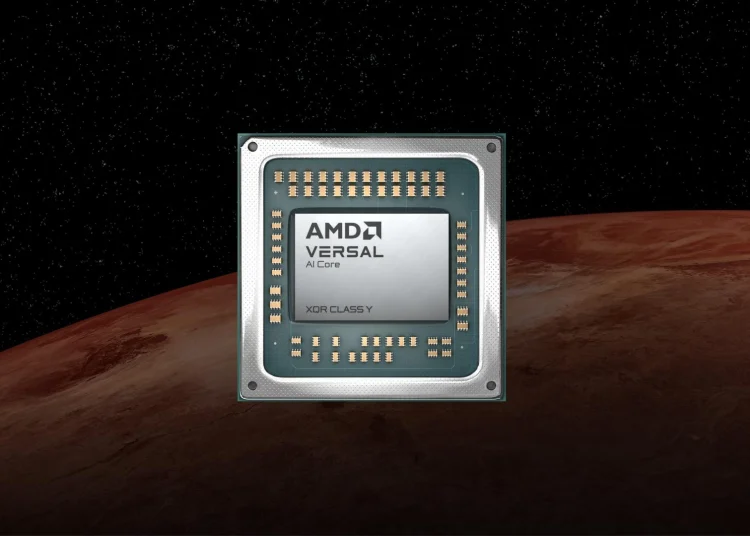
Beyond personal computing, AMD is pushing its AI innovations into space with the Versal AI Edge XQRVE2302 adaptive SoC, which recently received Class B spaceflight qualification. Designed for radiation tolerance, this chip enables accelerated AI inference in space applications, with AI Engines optimized for machine learning tasks.
The SoC integrates a dual-core Arm Cortex-A72 application processor, a dual-core Arm Cortex-R5F real-time processor, AI engines, DSP blocks, and FPGA programmable logic — all within a compact 23mm x 23mm package. This allows for robust edge processing in space, supporting functions like image detection, autonomous navigation, and sensor data analysis. Its design also allows unlimited reprogramming even after deployment, ensuring adaptability for evolving mission needs in harsh space environments.